.png)

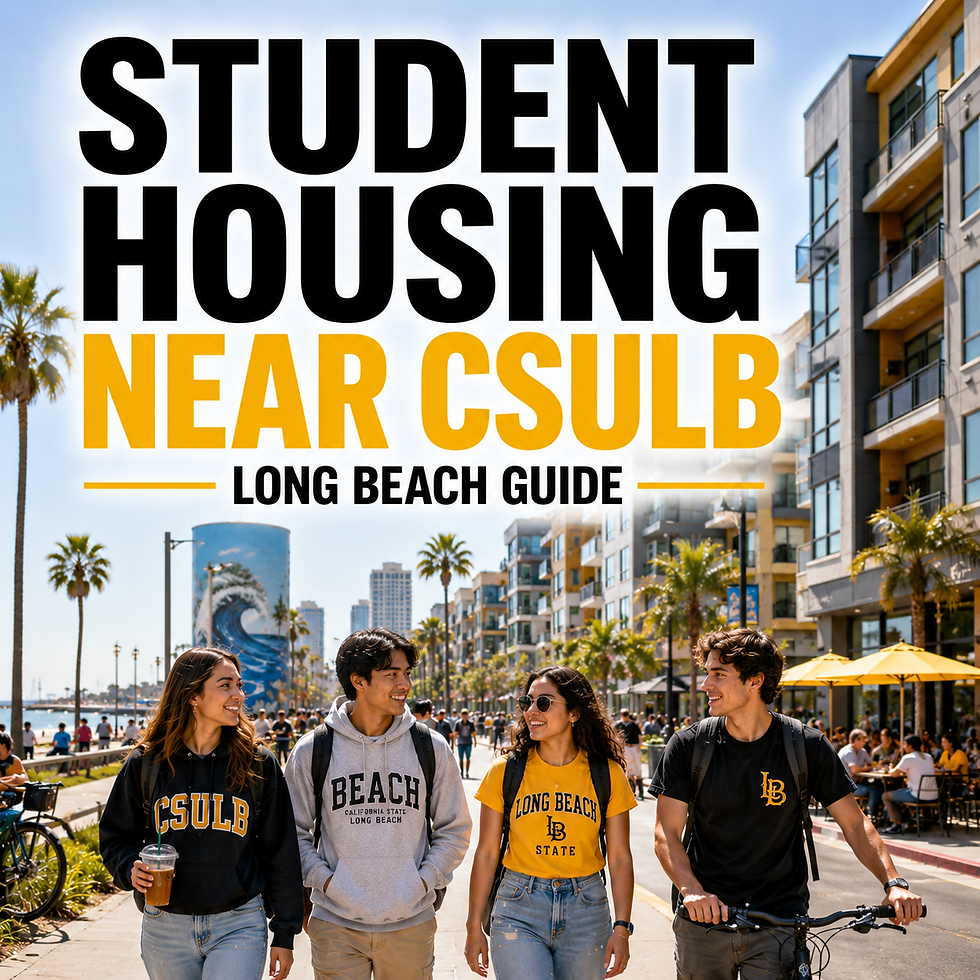
Student Housing Near CSULB: Long Beach Guide

Updated: Oct 2
Finding student housing near CSULB is far less about luck than about calendar. The Long Beach rental market turns over in waves, and the same apartment that looks impossible to get in August was sitting unclaimed in April. This guide walks the year month by month — when listings appear, when competition peaks, when a landlord will negotiate and when you should simply wait — with current prices taken from live pages on Off-Campus Universe.
Begin your search at Off-Campus Universe, where you can browse current listings near Long Beach and watch how the inventory changes from week to week. Checking the same search repeatedly over a month tells you more about this market than any single snapshot can, because what matters is not just what is available today but how quickly it disappears.
Four live Long Beach listings give you something concrete to calibrate against. 3440 E Ransom is listed at $1,025/month and sits at the affordable end of what currently appears near campus. Condo in down town Long Beach is listed at $1,900/month, a downtown condo of the type that tends to come back on the market in mid-lease rather than on the August cycle. Emerald Villas is live but its page prints no rent at all, so it is (contact for price) and you will have to ask — which is itself a timing lesson, because unpriced listings reward whoever calls first. And 9106 Dalberg Ave is recorded as a studio at $2,145/month, which is well above what a studio normally asks in this city; take the price exactly as the record states it, and ask the landlord to confirm what the unit actually is before you budget around it.
Long Beach Areas and When Each One Turns Over
The ring closest to campus — Los Altos along Bellflower Boulevard to the north, University Park Estates to the east, and the residential grid west toward Clark Avenue and Stearns Street — runs on the academic year more tightly than anywhere else in the city. Leases there are written to end in summer because the tenants are students, which means the inventory arrives in a burst and goes quickly. If this ring is where you want to be, you are competing in a compressed window and you should be looking months before you need the keys.
Belmont Shore and Belmont Heights, southwest of campus toward the water along Second Street, behave differently. They are desirable to young professionals as well as students, so turnover is spread across the year and summer is actually the worst time to look, because short-term beach demand pushes against you. Zaferia, on the Anaheim Street corridor west and northwest of campus, and Bixby Knolls and California Heights, north-central along the Atlantic Avenue corridor, are more conventional residential markets: units come up when a tenant moves, not when a semester ends, which makes them worth checking in the off months when the campus ring has nothing left.
Downtown Long Beach and the East Village Arts District are the most calendar-neutral part of the city. Larger managed buildings there lease continuously, often advertise concessions when a floor is sitting empty, and will happily start a lease mid-month. The trade is distance: downtown is several miles west of campus, so you are committing to a daily commute. Long Beach Transit runs buses across the city and the Metro A Line's Long Beach terminus is downtown rather than at the campus, so check the current routes and journey times for the specific address before you decide the commute is workable.
Student Housing Near CSULB: Timing Your Search Month by Month
A realistic calendar for student housing near CSULB looks like this. January and February are for groundwork: set your budget, settle who you are living with, and start watching listings so you learn what a fair price looks like before you need to act. March through May is when the campus-adjacent inventory for a fall start actually appears, and it is when most signing happens. June and July are thin and tense near campus, though downtown buildings are still leasing. August is the worst month to begin — you will be choosing from whatever nobody else wanted, at the top of the range.
The off-season has real advantages if your schedule allows it. A landlord with an empty unit in November or January is carrying the cost of that vacancy, and that is when a figure like the $1,025/month on Ransom is likeliest to come with a month of flexibility on the start date, or a willingness to leave an appliance behind. Mid-lease stock, like the downtown condo at $1,900/month, surfaces year-round for exactly this reason: somebody's plans changed. Searching in those windows means less competition for each unit and more room to ask questions before you commit.
Whatever the month, build in time between seeing a place and signing for it. Ask how long the listing has been up, whether the current tenant is leaving voluntarily, and when the unit will be empty enough to inspect properly. A unit you can only view with furniture in it and a tenant still living there is a unit whose floors, windows and appliances you have not really seen. If the landlord will not let you look again before the lease is signed, that is information too.

What a Rushed Signing Costs You
Hurry is expensive. The classic August mistake is paying a holding deposit on an unseen unit to take it off the market, then discovering that the deposit is non-refundable and the unit is not what the photographs showed. Never pay anything before you have seen the inside of the actual unit you would be renting — not the model, not a similar one upstairs — and never send money to someone who will not meet you at the property or produce proof they are entitled to rent it.
The second cost of hurrying is signing a lease you have not read. Joint and several liability means each named tenant can be pursued for the entire rent, not a share, so the people you sign with matter as much as the apartment does. Settle before signing what happens if someone leaves mid-year, and ask whether a replacement can be added by addendum. Check the subletting clause if you plan to go home over the summer, and check whether the lease rolls to month-to-month at the end of the term or requires a formal notice you will have forgotten about by then.
Finally, deposits. The California rules on deposit limits and return deadlines have changed recently enough that older guides are unreliable, so confirm the current rule rather than trusting a number you read somewhere. The part that protects you regardless is the record: photograph every room and every existing mark the day you get the keys, email the set to the landlord so it is dated on both sides, and keep the reply. Long Beach also has its own tenant protections beyond state law and coverage varies by property, so ask the landlord directly whether a given address falls under them.
Start watching listings three to five months before your move-in date, not three weeks.
Ask how long a listing has been up — a stale listing is where the negotiating room is.
Never pay a holding deposit before seeing the inside of the exact unit you would rent.
Confirm what an unpriced listing actually asks before you rule it in or out.
Ready to find your place? Browse all listings at Off-Campus Universe.
This article is provided by an independent housing resource and is not affiliated with, endorsed by, or sponsored by California State University, Long Beach.


Comments